How to Choose the Right Night Cream for Your Skin Type
- The Diagnostic Phase: Identifying Your Unique Skin Type
- The Ingredient Powerhouse: Molecular Workhorses for Repair
- Tailored Solutions: Selecting the Right Cream for Your Profile
- Advanced Skincare Science: MVE Technology and Absorption
- The Expert Methodology: Application and Routine Integration
- Safety and Trust: When to Seek Professional Guidance
- Conclusion: Investing in Your Future Skin
Most people focus their skincare energy on the morning. We apply sunscreens to block the sun and antioxidants to fight pollution. While protection is vital, the real health of your skin is determined while you sleep. Your skin has a biological clock that never stops. During the day, your skin is in “defense mode.” It is busy fighting off environmental stress. At night, your skin shifts into “repair mode.” This is the most important window for recovery because your body’s natural healing process speeds up while you rest.
While day creams are made to protect, night creams are made to repair. They usually have thicker, richer textures and higher amounts of active ingredients. Choosing a product is a major health decision for your skin, not just a beauty purchase. A good night cream supports your skin’s natural healing cycle. It fixes problems like dryness, fine lines, and irritation.
If you choose the wrong product, you might cause harm to your skin barrier. For example, a heavy cream on oily skin can cause painful breakouts. A light lotion on dry skin can leave the skin thirsty and weak. This guide will help you find a product that matches your skin’s unique biology. Before you can pick the right tool, you must master the science of your own skin.
The Diagnostic Phase: Identifying Your Unique Skin Type
You cannot treat your skin well if you do not know what it needs. Your skin is a living organ. It changes as you get older or as the weather shifts. To choose a night cream that offers real value, you must start with a proper diagnosis. In my clinical experience, I have seen many people use the wrong products because they did not understand their skin category.
The table below shows the five main skin types. It explains what they look like and what happens if you do not treat them correctly.
Skin Type Characteristics & Primary Challenges
| Skin Type | Visual Indicators | The “So What?” (Impact) |
| Normal | Small pores, smooth texture, healthy glow. | Needs gentle support to stay healthy and prevent early signs of aging. |
| Dry | Rough patches, visible flaking, feels tight. | High risk of deep wrinkles because the skin lacks the oil it needs to stay flexible. |
| Oily | Very shiny, large pores, frequent breakouts. | High risk of acne and clogged pores if oil is not balanced properly. |
| Combination | Shiny forehead and nose; dry or tight cheeks. | Requires a “zone” approach to avoid causing breakouts in oily areas or irritation in dry areas. |
| Sensitive | Redness, easy itching, reacts to new soaps. | Likely to suffer from a broken skin barrier; needs very calming ingredients to stay safe. |
Once you know your type, you can look for the “workhorses” of skincare. These are the molecules that do the heavy lifting while you sleep.
The Ingredient Powerhouse: Molecular Workhorses for Repair
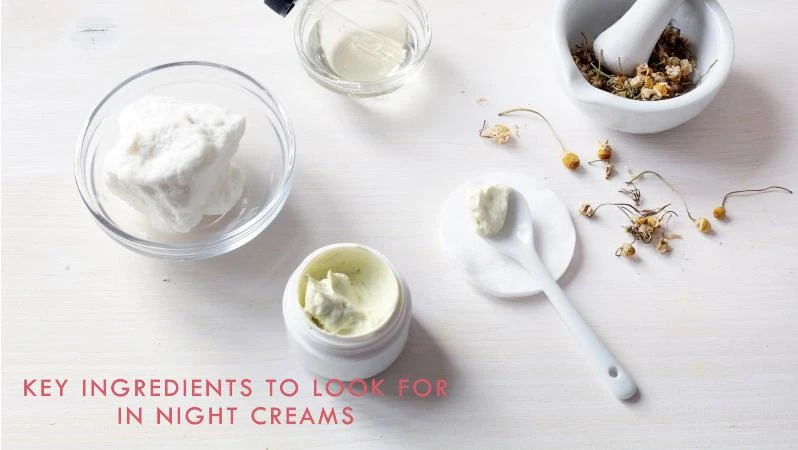
Ingredients are like tools in a toolbox. When you know what each molecule does, you can ignore the fancy labels and see the real value of a cream. Nighttime is the best time for these ingredients. The skin is not busy fighting the sun, so it can focus entirely on absorption.
Hyaluronic Acid: The Master Hydrator
Hyaluronic acid is a “humectant.” Think of it like a tiny, powerful sponge. It can hold 1,000 times its own weight in water. In a night cream, it pulls moisture into your skin. This makes your skin look “plump” and fresh when you wake up.
Ceramides: The Skin’s Mortar
Ceramides are natural fats. If your skin cells are like bricks in a wall, ceramides are the mortar that holds them together. They create a seal that keeps moisture in and keeps germs out. Without them, your skin’s wall falls apart, leading to dryness.
Peptides: The Collagen Builders
Peptides are small messengers. They tell your skin to make more collagen. Collagen is the protein that keeps your skin firm. By using peptides at night, you help your skin stay strong and smooth.
Retinol: The Gold Standard for Repair
Retinol is a form of Vitamin A. It is a true powerhouse for cell turnover. It tells old, tired skin cells to move out so new, healthy cells can take their place. Because Retinol can make skin sensitive to the sun, it is strictly a nighttime ingredient. It is the best tool we have for fighting wrinkles and uneven skin tone.
Niacinamide (Vitamin B3): The Great Balancer
Niacinamide is a very friendly ingredient. It calms down redness and helps control oil. It also makes the skin barrier stronger. It is gentle enough for almost everyone.
Antioxidants (Vitamins C & E): The Clean-Up Crew
Antioxidants stop “free radicals.” These are unstable molecules that damage your cells. While you sleep, Vitamins C and E help repair the damage done by the sun during the day.
Tailored Solutions: Selecting the Right Cream for Your Profile

A “one-size-fits-all” plan does not work for your health, and it does not work for your skin. To see real results, the formula must match your skin’s biology. Here is a deep look at how to choose for each profile.
Normal Skin
If you have normal skin, you are in a state of equilibrium. Your pores are small, and your oil levels are steady. However, “normal” does not mean “invincible.” Your goal is prevention. As a consultant, I recommend focusing on maintaining your moisture levels and protecting your future skin. You should look for a night cream that feels light but contains powerful peptides. These peptides act as messengers to keep your collagen levels high before wrinkles even start to form.
Even though your skin feels fine now, it still loses water at night. This is why Hyaluronic acid is still a must-have for you. It keeps that healthy glow from fading. You also want a dose of antioxidants like Vitamin E. Think of it as an insurance policy for your face. You want a cream that is non-greasy so you don’t wake up feeling “heavy.” By providing these gentle tools every night, you ensure that your skin stays in this perfect balance for as long as possible.
Dry Skin
Dry skin often struggles with a broken barrier. In medical terms, there are literal gaps in your “lipid bilayer.” This means moisture is constantly escaping, a process called “water loss.” This is why dry skin often feels tight or looks flaky. To fix this, you need a night cream that is “rich and emollient.” This means it should be thick and buttery. You need a formula that acts like a warm winter coat for your face.
The most important ingredients for you are ceramides and nourishing oils like jojoba or argan oil. These oils provide the fatty acids that your skin cannot make on its own. When you apply a thick cream, you are creating a physical seal. This seal stops water from leaving your skin while you sleep. I also recommend looking for Glycerin or Hyaluronic acid to pull water into those deep layers. If your skin is very dry, look for “overnight masks” which are even thicker than standard creams. This intense nourishment helps repair those gaps in your skin wall so you wake up with soft, flexible skin.
Oily Skin
Many people with oily skin make the mistake of skipping moisturizer. They think their skin is already too “wet.” However, oil is not the same as water. If you skip your night cream, your skin may get dehydrated. When this happens, your oil glands work even harder to compensate, making you even oilier. The secret is to use “non-comedogenic” and “oil-free” formulas. This means the cream is designed not to clog your pores.
For your profile, the best “workhorse” is Salicylic acid. This is a BHA (Beta Hydroxy Acid). Unlike many ingredients that only stay on the surface, Salicylic acid is oil-soluble. This means it can actually go down into the pore to dissolve the “glue” that causes blackheads. Pair this with Niacinamide to tell your oil glands to slow down. I recommend using a gel-cream texture. These feel like water on the skin and soak in immediately. This way, you get the hydration your skin needs without any of the shine or heaviness that leads to acne.
Combination Skin
Combination skin is like having two different faces at once. Your forehead, nose, and chin (the T-zone) might be very shiny, while your cheeks feel like parchment paper. This requires a very strategic approach. In my clinical practice, I often advocate for “zone-treating.” This means you don’t have to use the same amount of product everywhere. You might apply a very thin layer of a light lotion to your forehead, but a thicker, ceramide-rich cream to your dry cheeks.
If you want just one product, look for a “balancing” night cream. These are usually medium-weight lotions. They should contain Niacinamide, which is famous for helping both oily and dry areas at the same time. It helps the T-zone stay matte while helping the cheeks stay hydrated. Hyaluronic acid is also perfect here because it provides weightless moisture that won’t upset the oily parts of your face. By treating each zone with care, you can bring your whole face back into a state of harmony.
Sensitive Skin
Sensitive skin has a “hyper-reactive” immune response. It sees new ingredients as threats, which leads to redness, burning, or itching. Your skin barrier is often very thin or easily damaged. Therefore, your first rule is “less is more.” You must choose products that are strictly “fragrance-free” and “hypoallergenic.” Fragrance is the number one cause of skin reactions, so even if it smells like roses, it might be an enemy to your skin.
Your night cream should focus on “calming” the skin. Look for high amounts of Ceramides to rebuild your defenses. Niacinamide is also excellent for you because it lowers inflammation. I always tell my clients to perform a “patch test” first. This means putting a tiny bit of cream on your inner wrist or behind your ear. Wait 24 hours. If there is no redness, it is likely safe for your face. Avoid ingredients like alcohol or harsh essential oils. Your goal is to provide a “safety blanket” for your skin so it can rest without being irritated.
Advanced Skincare Science: MVE Technology and Absorption

The ingredients in your cream are only useful if they can get deep into your skin. In the past, most creams gave the skin a single “burst” of moisture. This would feel great at 10:00 PM, but by 3:00 AM, the effect was gone. Modern science has fixed this with MVE (Multi-Vesicular Emulsion) technology.
Think of MVE technology like a “timed-release sprinkler system” for your face. Instead of one big splash, the cream is made of tiny spheres. These spheres have many layers, like an onion. As each layer melts into your skin, it releases a new dose of ceramides and hyaluronic acid. This happens slowly over many hours.
This technology is a game-changer for people with very dry or dehydrated skin. It ensures that your skin receives a steady stream of nourishment throughout your entire eight-hour sleep cycle. Instead of waking up with that “tight” feeling, your skin stays hydrated until the moment you start your morning routine. This continuous delivery helps the skin barrier stay strong and healthy all night long.
The Expert Methodology: Application and Routine Integration
Even the best cream in the world will fail if you do not apply it correctly. Think of your skin as a canvas. You must prepare the canvas before you can paint. Follow these steps for the best results:
- Cleansing: You must remove the day. This means washing away makeup, dirt, and pollution. If your pores are blocked, your night cream will just sit on top and do nothing.
- Preparation: If you use serums (like a Vitamin C or a treatment serum), apply them first. These are usually thinner and need to touch the skin directly.
- Application: Take a small, pea-sized amount of night cream. Dot it on your forehead, cheeks, and chin.
- The Upward Motion: Gently massage the cream into your skin using “upward motions.” In my experience, this is the best way to support your skin’s structure. It helps with blood flow and prevents you from pulling your skin downward.
- Timing: Give the cream at least ten minutes to “settle” before your face hits the pillow. You want the cream in your skin, not on your bedsheets.
Consistency is the most important part. Skincare is a marathon. You might feel soft after one night, but it takes about four to six weeks to see a real change in wrinkles or skin tone. This is because it takes that long for your skin cells to renew themselves.
Safety and Trust: When to Seek Professional Guidance
Skincare is a “Your Money or Your Life” (YMYL) topic. This means that making the wrong choice can affect your health and safety. While most night creams are very safe, some active ingredients require extra caution.
If you are using high concentrations of Retinol, your skin might become very dry or peel at first. This is often normal, but it can be scary. This is why I always recommend speaking with a medical professional or a licensed aesthetician if you have concerns. They can help you decide if a product is right for your specific health history.
If you have chronic skin issues like severe acne, eczema, or rosacea, you should not guess which cream to buy. A doctor can give you a medical-grade plan that keeps you safe. Remember, the goal of skincare is health. If a product causes lasting pain or severe redness, stop using it immediately. Your safety is more important than any “glow.”
Conclusion: Investing in Your Future Skin
Choosing a night cream is a powerful way to invest in your long-term health. By understanding the biological clock of your body, you can give your skin exactly what it needs to repair itself. Whether you need the oil-soluble power of Salicylic acid or the “mortar” of Ceramides, the right tools will help you wake up with a radiant complexion.
Your skin is unique to you. It may take some time and patience to find the perfect match, but the effort is worth it. When you finally find the right night cream for your skin type, you are giving your skin the ultimate gift of rest and renewal. Wake up every morning to skin that feels nourished, strong, and ready to face the world.
il you find the perfect night cream for your skin. With patience and consistency, you’ll be on your way to waking up with glowing, nourished skin every morning.
- Benefits of Night Cream and Why You Should Use It
https://www.skinician.com/blogs/product-guides/benefits-of-night-cream - WHY YOU NEED A NIGHT CREAM IN YOUR SKINCARE ROUTINE
https://www.lizearle.com/content/choosing-the-right-night-cream.html - Get glowing skin: how should I choose my night cream
https://www.lorealparis.com.my/beauty-magazine/get-glowing-skin–how-should-i-choose-my-night-cream- - Why Use a Moisturizer at Night? Your Guide to Choosing Our Best Nighttime Skincare
https://theordinary.com/en-us/blog/benefits-of-a-night-cream.html