LED Light Therapy vs. Other Light-Based Treatments: For Glowing Skin

What Are Light-Based Treatments?
There are many ways to use light to help your skin look better. It can be confusing because there are so many names, like LED, laser, and IPL. These are all types of light-based facial treatments.
Think of these treatments as different tools in a toolbox. Some are gentle like a soft brush, and others are powerful like a hammer. Each one works in a special way to help with different problems like wrinkles, acne, or dark spots. In this guide, we will look at:
- LED Light Therapy
- Laser Skin Resurfacing
- IPL (Intense Pulsed Light)
- PDT (Photodynamic Therapy)
- LLLT (Low-Level Light Therapy)
1. LED Light Therapy: The Gentle Power of Color

LED stands for Light Emitting Diode. Imagine using special colored light bulbs on your skin. Unlike some other lights, LED does not get very hot, and it does not hurt. It is a non-invasive treatment, which means it does not break the skin.
How Does It Work?
LED works by sending “messages” to your skin cells. Scientists have found that different colors of light reach different depths in your skin:
- Blue Light (415nm): This stays near the surface. It is famous for killing the bacteria that cause acne.
- Red Light (633nm): This goes deeper into the middle layer of your skin. It tells your cells to make more collagen, which keeps your skin looking young and bouncy.
- Yellow Light (590nm): This helps reduce redness and helps your skin heal faster.
- Green Light (525nm): This is often used to help fade dark spots and even out your skin tone.
Because it is so gentle, it is like a whisper to your cells. It is very safe for almost all skin types.
2. Laser Treatments: The Focused Superhero Beam
If an LED is like a gentle nightlight, a laser is like a powerful, focused spotlight. A laser uses just one single color of light in a very strong beam.
Two Main Types of Lasers:
- Ablative Lasers: These are very strong. They actually remove the very top layer of your skin. This sounds scary, but it helps new, fresh skin grow back in its place. It is great for deep scars or very old wrinkles.
- Non-Ablative Lasers: These are gentler. They do not remove the top layer of skin. Instead, they heat up the skin underneath to make it tighter.
Lasers are often the best choice for pigmentation removal (getting rid of dark spots) because they can target the color very specifically. However, they often have more downtime, which means your skin might be red or peeling for a while after the treatment.
3. IPL (Intense Pulsed Light): The Bright Camera Flash
IPL is sometimes called a “photofacial.” It is not exactly a laser. Instead of one color of light, it uses many different colors all at once, kind of like a camera flash.
Why Use IPL?
Because it uses many colors, it can help with a few things at the same time. It is very good for:
- Sunspots: Fading those brown spots from being in the sun.
- Redness: Helping with tiny red lines on your face, often called vascular lesions.
- Rosacea: Helping people who have very red skin on their cheeks and nose.
IPL is a medium-strength treatment. It is stronger than an LED but usually not as intense as an ablative laser.
4. Photodynamic Therapy (PDT): The Team Effort
PDT is a very special medical treatment. It uses two things: a special cream and a specific light.
First, a professional puts cream on your skin. This cream makes “bad” cells (like acne bacteria or damaged cells) very sensitive to light. Then, they shine a light on the skin. The light activates the cream, which then kills the bad cells. Doctors use this for very bad acne or even for skin problems that could turn into cancer.
Head-to-Head: How Do They Compare?
| Feature | LED Therapy | Laser Treatments | IPL Therapy | PDT |
|---|---|---|---|---|
| How it feels | Very relaxing and comfortable | Can feel like a snap or sting | Feels like a rubber band snap | Can feel like stinging or burning |
| Recovery Time | No downtime; go back to work | Days or weeks of peeling/redness | A few hours or a day of redness | Days of redness and peeling |
| Number of Sessions | Many (once a week for months) | Few (often 1 to 3) | Medium (usually 3 to 6) | Very few (1 to 3) |
| Safety | Very safe for everyone | Higher risk of burns or scars | Can be risky for dark skin | Makes skin very light-sensitive |
Choosing the Best Treatment for Your Problem
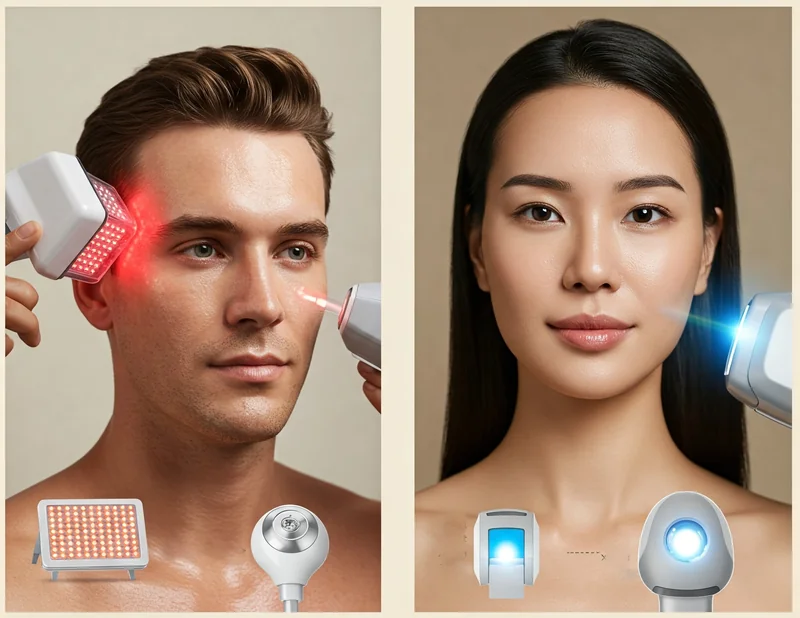
Best for Anti-Aging
If you want to reduce wrinkles and make more collagen, you have choices.
- LED (Red Light): Best if you want a gentle, slow improvement with no pain.
- Lasers: Best for deep wrinkles if you don’t mind a few days of recovery time.
- IPL: Good for a mix of wrinkles and sunspots.
Best for Acne
- LED (Blue Light): Perfect for mild acne and keeping skin clear.
- PDT: Often the best choice for very severe acne that other treatments can’t fix.
Best for Dark Spots (Pigmentation)
- Lasers: These are usually the most effective at removing dark spots quickly.
- IPL: A great second choice that also helps with redness.
Can You Combine Treatments?
Yes! Sometimes using a “team” of lights works best. This is called hybrid light therapy.
- IPL + LED: You can use IPL to target spots and then use LED to help your skin heal faster and make more collagen.
- Laser + LED: Using red LED light after a laser treatment can reduce swelling and help you recover much faster.
Always talk to a professional before mixing treatments to make sure it is safe for your skin type.
Safety and What to Know Before You Go
While light therapy is amazing, there are some contraindications (reasons you should not get it):
- Pregnancy: Many doctors suggest avoiding these treatments while pregnant.
- Light Sensitivity: If you have a condition like Lupus, some lights might hurt your skin.
- Skin Cancer: Always talk to your doctor if you have had skin cancer before getting light treatments.
- Medications: Some pills can make your skin extra sensitive to light.
Important Tip: Always wear eye protection! The lights used in these machines are very bright and can hurt your eyes if they are not covered.
Is It Worth the Money?
The cost of these treatments can vary a lot.
- At-Home LED Devices: These cost the least but are the weakest.
- Professional LED and IPL: These cost more but are stronger.
- Lasers: Usually have the highest price because the machines are very expensive and powerful.
When thinking about the cost-effectiveness, remember to count how many sessions you will need. LED is cheaper per session, but you need many more of them. Lasers are expensive, but you might only need one or two.
The Future of Light Treatments
The world of light-based technologies is always changing. Scientists are now using Artificial Intelligence (AI) to help machines pick the perfect settings for your skin. They are also making LED lights that can go even deeper into the skin to fix problems without any heat or pain.
Final Takeaway: Finding Your Perfect Match
The best treatment depends on your specific skin, your budget, and how much “downtime” you can afford.
- Pick LED if you want something safe, easy, and relaxing.
- Pick Laser if you want fast, big changes and can stay home for a few days to heal.
- Pick IPL if you have a mix of sunspots and redness.
Before you decide, find a good provider. Ask them about their training and what kind of machines they use. By asking the right questions, you can find the perfect light to help your skin shine.
Choosing the right light for your face can feel like a big job, but now you know the most important differences. When looking at LED light therapy vs other light-based treatments, remember that one choice is not always “better” than the others. Instead, the best match for you depends on what your skin needs, how much money you want to spend, and if you can take a few days off to heal.
LED therapy is like a gentle whisper that helps your skin slowly over time with no pain. Lasers and IPL are stronger tools that act like a powerful spotlight to fix deeper problems faster, but they might need more recovery time. This guide was created to move past simple facts and give you the deep details needed for a high-quality and helpful experience.
Our goal is for you to leave this page feeling that you have had a satisfying experience and have learned everything you need to reach your skin goals. By understanding how these lights work, you are now ready to talk to a professional and find the perfect glow for your skin
Sources:
- LED Light Therapy
https://my.clevelandclinic.org/health/treatments/22146-led-light-therapy - IPL Versus LED Red Light Therapy for Facial Skin
https://naderm.com/blog/ipl-versus-led-red-light-therapy-for-facial-skin/ - The History of Red Light Therapy
https://platinumtherapylights.ca/blogs/news/the-history-of-red-light-therapy - Understanding Laser vs Red Light Therapy
https://strengthchiro.com/blog/understanding-laser-vs-red-light-therapy - Low Level Laser Therapy
https://www.physio-pedia.com/Low_Level_Laser_Therapy - Intense Pulsed Light (IPL) Treatment
https://www.webmd.com/beauty/intense-pulsed-light-treatment-overview - Ablative Laser Resurfacing vs. Non-Ablative Laser Treatments: Choosing the Right Option for You
https://clderm.com/ablative-laser-resurfacing-vs-non-ablative-laser-treatments-choosing-the-right-option-for-you/ - Choosing the Right Light-Based Treatment: LED, Laser, or IPL?
https://discoverheirloom.com/blogs/blog/choosing-the-right-light-based-treatment-led-laser-or-ipl - The Ultimate Checklist For Choosing A Color Light Therapy Clinic Near You
https://www.pleasanthillsanctuary.com/color-light-therapy/the-ultimate-checklist-for-choosing-a-color-light-therapy-clinic-near-you - The role of lasers and intense pulsed light technology in dermatology
https://pmc.ncbi.nlm.nih.gov/articles/PMC4745852/ - Advice for providers: Lasers, IPL devices and LED phototherapy for cosmetic treatments and beauty therapy
https://www.arpansa.gov.au/understanding-radiation/sources-radiation/more-radiation-sources/lasers-and-intense-pulsed-light-1 - Photodynamic therapy (PDT)
https://www.nhs.uk/conditions/photodynamic-therapy/ - Benefits of Radio Frequency and Red Light Therapy on Skin Health
https://www.redlighttherapycenter.com/blog/benefits-of-radio-frequency-and-red-light-therapy-on-skin-health

Meet Donna: Founder & Lead Curator
Hi, I’m Donna, the voice and vision behind Aesthetic Thrive.
As a professional digital content creator and wellness strategist, I founded this platform to simplify the journey toward a more beautiful, balanced life. My background is rooted in a deep passion for fashion, intentional living, and holistic health. For years, I have dedicated my career to researching how the environments we build both within our bodies and in our homes directly affect our daily confidence and long-term well-being. Read More!